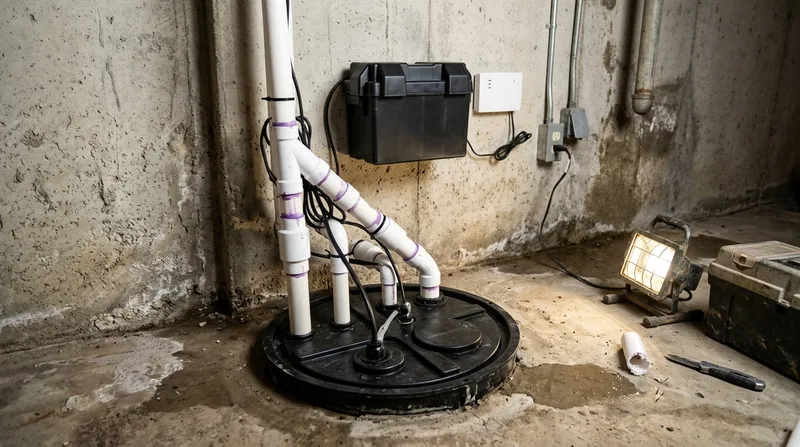




Springfield sits on the Ozarks plateau, where cherty red clay and karst limestone move water underground fast and dump it into sump pits just as fast. When a spring thunderstorm stalls over the James River valley or an ice storm knocks the grid out for days, the pump that kept your basement dry is the first thing to quit. Battery Backup Sump Pumps in Springfield keep the basin emptying when the power dies, which is exactly when the water table is climbing. Whether you own a limestone-foundation Victorian in Midtown or a poured-wall walk-out in Nixa, the backup is the difference between a wet basement and a dry one. We size every unit to the pit, the inflow rate, and the discharge head, not to a shelf label. Start with a sump pump installation and replacement review so the primary and backup work as one system.
Why Springfield Basements Need a Backup Pump, Not Just a Primary
The dominant failure mode here is not a dead pump, it is a dead circuit. Ozarks thunderstorms roll through with lightning that takes out transformers, and ice storms like January 2007 left whole blocks of Springfield dark for a week or more. Add the spring water table rising through karst springs and sinkholes, and a primary pump with no backup is a single point of failure. Homes in Rountree and Phelps Grove on partial basements fill faster than owners expect once the cherty clay is saturated.
- Grid outages during spring storms stop the primary pump while inflow is still climbing.
- Freeze-thaw winters crack discharge lines, and a backup keeps running through the thaw.
- Older limestone and brick foundations in the Walnut Street district seep under hydrostatic pressure the moment pumping stops.
- Homes in Nixa and Republic with walk-out lower levels collect water at the low wall first.
We treat the backup as part of the drainage system, not an accessory bolted on after the fact.
Key info: A sump pump that loses power during a storm is the same as no pump at all. In Springfield, the backup battery is what carries the basin through the outage until the grid returns.
For local code and permit questions on discharge connections, check the City of Springfield building department before work begins.
How We Install a Battery Backup Sump Pump in Springfield
We start by measuring what the pit actually handles. That means watching the float cycle, checking the inflow rate during a rain, and confirming the discharge line has the head pressure to push water out to grade. Then we match the battery and charger to that load, so the unit runs for hours, not minutes. Every install ends with a simulated outage test, not a guess.
- We inspect the existing pit, pump, check valve, and discharge line for capacity and backflow issues.
- We size the backup battery and charger to your inflow rate and required run time.
- We mount the backup pump and float at the correct height above the primary.
- We tie the discharge into the existing line with a dedicated check valve.
- We install the alarm where you will hear it from the living space.
- We cut power at the breaker and confirm the backup carries the basin on its own.
If the pit itself is undersized or the drain tile is silted, we flag it before selling you a battery that solves the wrong problem.
Key info: On a 1950s brick ranch off Glenstone, the primary pump ran fine until an August storm tripped the breaker. The backup we installed held the basin for six hours until power returned, and the alarm told the owner the primary had stopped.
If the pit is dry but the walls weep, the backup is not the fix. See our interior drain tile system page for how we move water to the basin in the first place.
Backup Pump Options We Install in Springfield
Not every basement needs the same hardware. A partial basement in Rountree with a shallow pit calls for a different setup than a deep poured basin in a southeast Springfield walk-out. We match the approach to the pit, the inflow, and how long outages typically last on your block.
| Approach | Description | Best for |
|---|---|---|
| Battery backup pump in the same pit | A second pump and float mounted above the primary, driven by a charged battery. | Most Springfield homes with an existing working primary pump. |
| Combination primary and backup unit | One housing with a line-powered primary and a battery-driven secondary. | Tight pits and replacements where the old pump is at end of life. |
| High-capacity battery with charger | Larger battery bank and smart charger for longer run times. | Deep basins and homes that see multi-day ice storm outages. |
| Alarm and monitoring add-on | Audible alarm plus a float sensor that reports high water or a dead battery. | Finished basements and homes where the pit is out of earshot. |
We will tell you plainly when a simple battery swap is enough and when the pit or discharge line needs attention first.
Battery Backup Sump Pumps Cost in Springfield: What to Expect
Most battery backup installations in Springfield start around $900, and that figure covers the pump, battery, charger, check valve, and the outage test. The number moves with pit depth, discharge head, whether the existing primary pump is sound, and whether you want a high-capacity battery for longer outages. A combination unit replacing a tired primary costs more than adding a backup beside a healthy one.
Access matters too. A pit tucked under a finished stair in a Phelps Grove bungalow takes more labor than an open basin in a Nixa mechanical room. We quote the actual scope after looking at the pit, not from a phone description. Getting two or three estimates is smart, and we will explain what each one includes so you can compare like for like. Our full pricing overview lays out how the line items break down.
We do not upsell a high-capacity battery to a homeowner whose outages last an hour, and we do not undersize a unit for a basement that floods every April.
What to Look for in a Waterproofing Contractor Near Springfield
Battery backup work is small enough that almost anyone will quote it, which is exactly why you should check credentials before you book. Ask whether the company is licensed and insured for work in Missouri, and ask for the certificate, not just a verbal yes. Get two or three written estimates with the battery model and run time spelled out. And ask who does the outage test, because a backup that was never tested is a backup you cannot count on.
Permits come into play when the discharge line ties into a sanitary connection or alters drainage, and the rules vary by jurisdiction, so confirm with the City of Springfield building department. If your home is in a historic district like Walnut Street, exterior changes may need review. We are a Basement Health Association member and carry a transferable warranty on the work. Reach out through our contact page to schedule a look at your pit.
Ask for references from nearby jobs and call one. A contractor who has installed backups in Springfield basements will have no trouble producing them.
Battery Backup Sump Pumps in Springfield: Pricing Guide
| Service | Price | Details |
|---|---|---|
| Battery backup pump added to an existing pit | Starting at $900 | Includes pump, battery, charger, check valve, and a simulated outage test. |
| Combination primary and backup unit | Starting at $1,350 | Replaces a tired primary pump and adds battery backup in one housing. |
| High-capacity battery and smart charger | Starting at $1,600 | Longer run time for deep basins and multi-day ice storm outages. |
| Alarm and high-water monitoring add-on | Starting at $250 | Audible alarm plus float sensor for pits out of earshot. |
| Complex or large-scale job | On estimate | Undersized pits, silted drain tile, or discharge line rework need an on-site look. |
| Estimate | Free | Response within 24 hours at (417) 738-3368, no obligation to book. |
Indicative pricing, the exact cost depends on square footage, finish, and site access. Free personalized estimate within 24h at (417) 738-3368.


