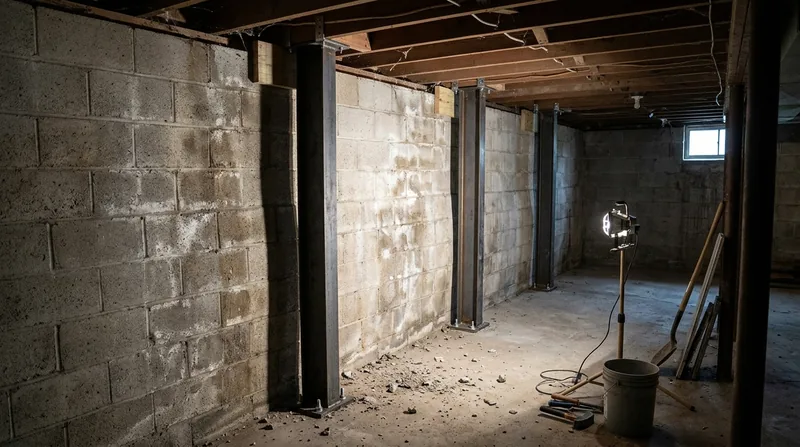




Bowing Wall Repair in Springfield: When Red Clay Pushes Back
Springfield sits on the Ozarks plateau, where cherty red clay over karst limestone holds water against your foundation longer than it should. If you have noticed a wall leaning inward, a horizontal crack widening at mid-height, or doors that suddenly stick in a Rountree bungalow or a south-side brick ranch, you are looking at Bowing Wall Repair in Springfield territory. Our crew stabilizes failing basement walls with carbon fiber straps, steel I-beams, or wall anchors, matched to how far the wall has moved and what the soil is doing. We are a Basement Health Association member and we work below grade only, so we read wall movement the way a waterproofing specialist should. Start with a free basement inspection and we will tell you plainly whether you need stabilization or just better drainage.
Why Bowing Walls Are Common in Springfield's Older Basements
Most of the bowing walls we open up in Springfield are block or brick walls built before 1960, from Walnut Street to Phelps Grove to Galloway. Those walls were never designed for the hydrostatic pressure that saturated Ozarks clay generates after a heavy spring storm. When the water table rises and the footing drain is clogged or collapsed, the clay pushes inward and the wall bows at mid-span. Freeze-thaw winters make it worse, because water in the wall pores expands and opens the mortar joints a little more each year.
- Horizontal cracking near the middle of the wall usually means soil pressure, not settlement.
- Walls that lean inward at the top often point to a failing floor or roof connection above.
- Efflorescence and white powder on the block tell you water is moving through the wall.
- Doors and windows that stick on the basement level are an early warning sign.
- Homes under mature oaks and hickories often have root systems that keep clay saturated longer.
If any of these signs are present, get the wall looked at before the next rainy season, because movement rarely reverses on its own.
Key info: A 1920s foursquare in Rountree had a block wall bowing nearly 2 inches after years of clogged footing drain. Carbon fiber straps on the interior face stopped the movement without excavating the driveway.
For permit requirements on structural foundation repair, check with the City of Springfield Building Development Services before work begins, since rules vary by jurisdiction: springfieldmo.gov.
How We Diagnose and Stabilize a Bowing Wall in Springfield
We start by measuring the wall, not guessing at it. A plumb line and a level tell us how much the wall has moved and in which direction. We also look at the drain tile, the grading, and the downspout extensions, because a wall that keeps taking water will keep moving even after it is braced. Then we match the repair to the severity and to your soil.
- We map the crack pattern and measure deflection at the worst point of the wall.
- We check the footing drain and sump system to see whether water is being managed or just pooling.
- We recommend carbon fiber straps for walls that have moved less than about 2 inches and are still stable.
- We use steel I-beams or wall anchors when the wall has moved further or the soil load is high.
- We address the water source with drainage so the repair is not fighting a losing battle.
Every recommendation comes with a plain explanation of what the repair does and does not fix.
Key info: A split-level in southeast Springfield had a block wall bowing toward the lower level. We installed steel I-beams and tied the repair to a interior drain tile system to relieve the pressure that caused the movement.
Bowing Wall Repair Methods We Use
The right method depends on how far the wall has moved, what the wall is made of, and how the soil is behaving. We do not sell one system for every house.
| Approach | Description | Best for |
|---|---|---|
| Carbon fiber straps | Straps bonded to the interior wall face resist further inward movement. | Minor bowing under 2 inches on block walls |
| Steel I-beams | Vertical beams anchored to the floor and joists hold the wall in place. | Moderate to severe movement and heavier soil loads |
| Wall anchors | Plates on the exterior soil side pull the wall back with rods through the wall. | Walls with room to excavate outside and significant deflection |
| Drainage correction | Relieving hydrostatic pressure with drain tile, grading, and downspout extensions. | Walls that are wet and showing early movement |
We frequently combine two methods, because bracing a wall without relieving the water pressure behind it is only half a repair.
Bowing Wall Repair Cost in Springfield: What to Expect
Pricing for bowing wall repair starts at $600 for a limited stabilization scope and climbs from there depending on how many straps or beams the wall needs and how much drainage work has to be done first. A single wall with modest movement is a smaller job than a full basement with multiple bowed walls and a failed footing drain. Access matters too: a wall behind a finished basement or under a deck is slower to work on than an open wall. We give you a written scope so you can compare apples to apples with other bids.
Get two or three estimates and ask each contractor what method they propose and why. A contractor who quotes a price without measuring the wall is guessing. Our full pricing overview explains what moves the number up or down.
Choosing a Bowing Wall Repair Contractor Near Me in Springfield
Ask for proof of licensing and insurance before anyone touches your foundation, and get a certificate of insurance sent directly from the carrier. Ask how long the company has worked on Springfield's older brick and block foundations, because a contractor who mostly does new poured walls may not read old mortar the same way. Check references from jobs similar to yours, and confirm who pulls the permit if structural work is involved. If your home is in a historic district or under an HOA, verify the exterior work rules before signing.
We are happy to walk you through our credentials and past work. Reach out through our contact page to schedule a free inspection.
Bowing Wall Repair Near Me: What Springfield Homeowners Should Know
Wall movement is not something to monitor for years and hope resolves. In Springfield's clay, a wall that has bowed an inch often keeps moving through the next wet spring. If you see a horizontal crack widening, call (417) 738-3368 and we will measure it and tell you where it stands. For neighbors in Nixa and Republic with newer poured basements, the same rules apply: water pressure is the cause, and bracing without drainage only buys time.
We serve Springfield and the surrounding communities with the same below-grade focus, and we will tell you honestly when a simple crack repair is enough and when the wall needs structural stabilization.
Bowing Wall Repair in Springfield: Pricing Guide
| Service | Price | Details |
|---|---|---|
| Carbon fiber strap stabilization | Starting at $600 | Covers limited strap installation on a wall with minor movement; number of straps and wall length drive the price up |
| Steel I-beam reinforcement | Starting at $1,800 | Includes beam placement and anchoring; wall height, beam count, and basement access affect the final figure |
| Wall anchor system | Starting at $2,500 | Exterior excavation and anchor plates included; soil conditions and depth of excavation move the number |
| Combined stabilization and drainage | On estimate | Needs an on-site look because drain tile scope, sump work, and wall severity vary widely |
| Travel | Included | in Springfield and surrounding areas, no separate call-out or mileage fee |
| Estimate | Free | Response within 24h at (417) 738-3368, no obligation to book |
Indicative pricing, the exact cost depends on square footage, finish, and site access. Free personalized estimate within 24h at (417) 738-3368.


